
|
Getting your Trinity Audio player ready...
|
This summer, Earthworks embarked on a road trip with partners that started in the Permian Basin, which spans from West Texas to Southeastern New Mexico, and ended on the Texas Gulf Coast. Record-breaking production of oil and gas in the Permian Basin has made the U.S. the world’s top oil and gas exporter, causing environmental and health harms in communities all along the supply chain. This is the second blog in a series documenting those harms. Click here to read the first.
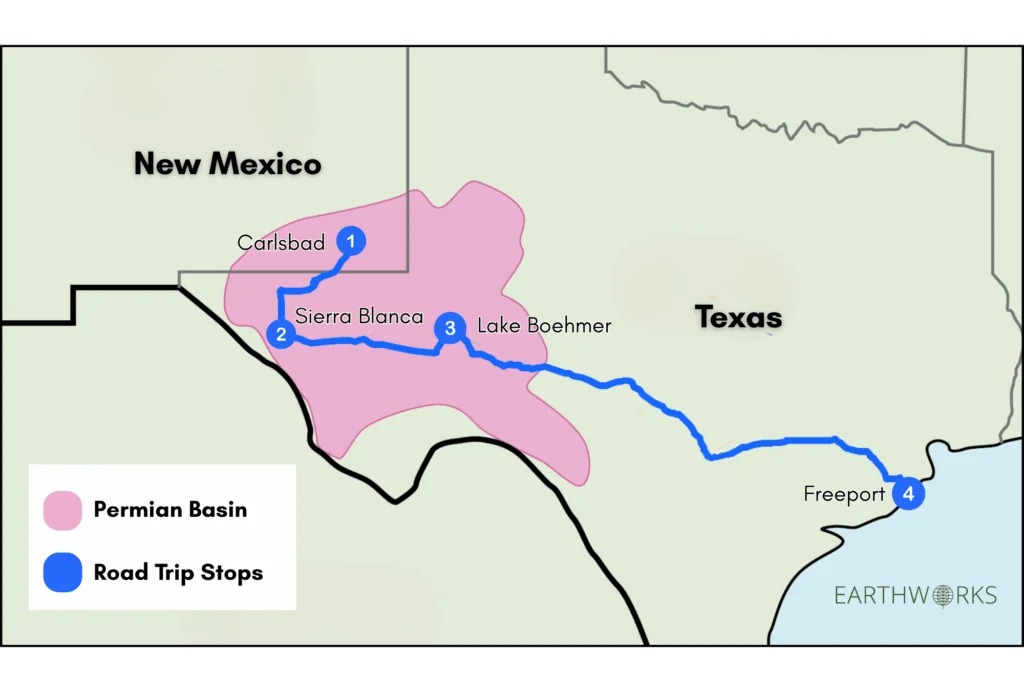
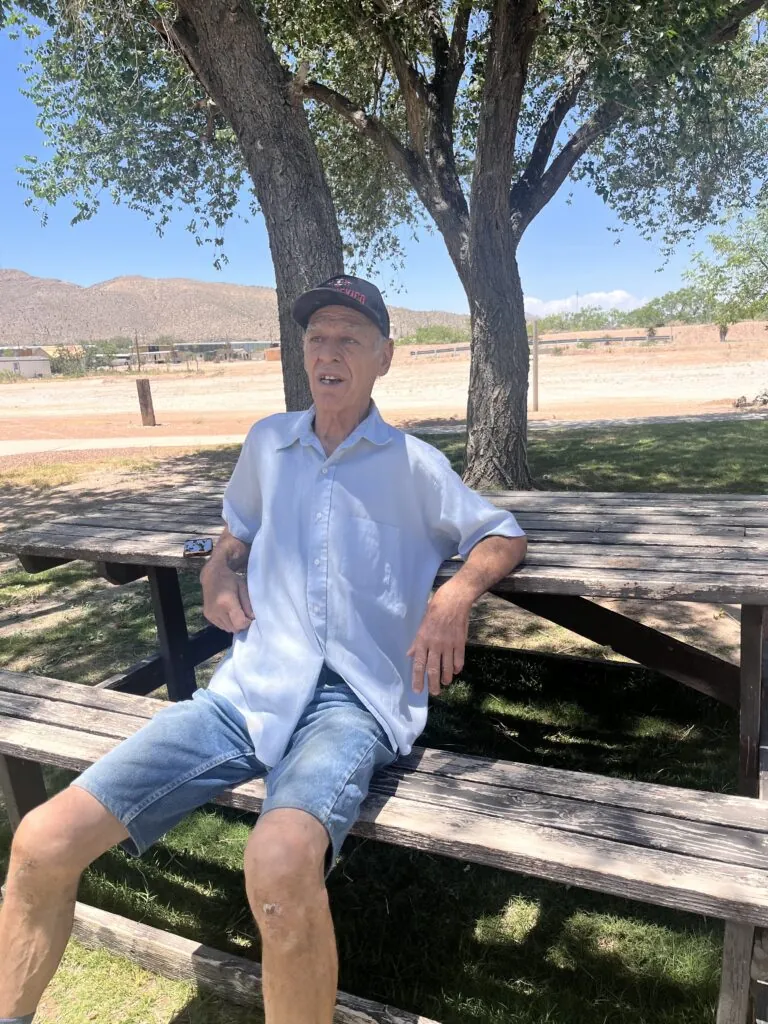
From Carlsbad, New Mexico we traveled south to the small desert town of Sierra Blanca, Texas, where we met with Bill Addington, a life-long environmental justice activist and founder of the Sierra Blanca Legal Defense Fund. Just 20 miles north of the U.S.-Mexico border, the 650-person town has a history of environmental struggles: many of which Bill has been at the forefront of. As Bill gears up to oppose a massive liquified “natural” gas (LNG) pipeline proposed in his county, he recounts the power of diverse coalitions and years of sustained advocacy in protecting his community from devastating pollution.
Throughout the 1990s, the former grocery store owner successfully led the charge against a radioactive waste dump, which would have discarded radioactive waste all the way from Vermont and Massachusetts just 5 miles from his home. Then-Governor George Bush had offered to dump the nuclear waste in the remote, low-income, predominantly Mexican-American town in exchange for $55 million from the New England states. The dump risked contaminating soil and groundwater in aquifers connected to the Rio Grande, which runs along the Texas-Mexico border, meaning the entire river would have been compromised.
“People don’t think about it, but really, there’s so much life in the desert,” Addington said.
From jackrabbits to cacti, deserts are complex and fragile, complex ecosystems. The communities and animal species that live in them depend on fresh water, which is often scarce or limited.
Today, climate change has intensified droughts across the U.S. Southwest. Locals account that seasonal rains have slowed and even drought-resistant cacti are dying off. While the summer 2025 saw an uptick in rainfall, the region has experienced increasing drought over the past two decades. The region is also experiencing less snow in the Sacramento Mountains, which is responsible for recharging the aquifers.
Addington’s next fight, the proposed Saguaro Connector Pipeline, would carry 3 billion cubic feet per day of gas 157 miles from the Permian Basin, through Sierra Blanca’s neighboring town, Van Horn, and under the Rio Grande. It would then connect to a 500 mile pipeline planned for construction across Mexico that would carry the gas to Puerto Libertad on Mexico’s Pacific coast. There, the gas will be liquified and exported to Asian markets. The tanker ships carrying the LNG would cut through the Gulf of California, often touted as the “aquarium of the world” for its abundant biodiversity and critical birthing grounds for whales.
Were the pipeline built, it would carry risks for the communities and wildlife from its start to finish. Construction of the 48-inch pipeline would leave destruction across its entire pathway, including digging under the Rio Grande and blasting through the nearby Quitman Mountains, threatening a sacred indigenous site known as Indian Hot Springs, once an oasis to the Carrizo/Comecrudo Tribe of Texas. Like all gas pipelines, the Saguaro Connector risks fires, leaks, explosions and groundwater contamination. Locals in nearby Van Horn worry their town would not have adequate emergency management capacity to respond.
Designed to let U.S. companies export more gas, more quickly, the Saguaro Pipeline would lock us into decades more of climate-warming fossil fuel emissions. Burning dirty fossil fuels will only intensify extreme weather, like the heat waves and droughts that are making life more difficult in the southwest.
Despite the multitude of harms, both state and federal agencies have rubber stamped the pipeline. The Federal Energy Regulatory Commission (FERC) has only claimed jurisdiction over a small, 1,200-foot segment of the pipeline. At the state level, the Texas Rail Road Commission – which regulates oil and gas, not railroads – claimed eminent domain over the pipeline’s route, meaning residents living along the pipeline’s route can be forced off their land if they do not accept a buy-out.
“The state of Texas has no love for our heritage,” Addington said.

In 1998, after nearly a decade of opposition, the Sierra Blanca nuclear waste dump project was shut down by the state of Texas. Many attribute the success of Addington and his allies to the breadth of their coalition: 22 U.S. towns and 17 counties along with two Mexican states had passed resolutions in opposition. Hundreds of residents, from both sides of the border, had stood up and spoken out, protesting on international bridges and lobbying Congress to protect their communities and their water.
Today, Addington is working with Sierra Club and other allies across West Texas to gear up the fight against LNG pipelines as well as nearby AI facilities and data centers, which are notorious for the amount of fresh water and energy they require to operate.