
|
Getting your Trinity Audio player ready...
|
Earlier this summer, Xinka People in Guatemala and their allies around the globe gathered online and in person to celebrate something remarkable: nine straight years of standing guard against the Escobal silver mine. Day and night, in rain and heat, community members have taken shifts watching the road, making sure it stays closed to mine related traffic. It is one of the longest-running Indigenous resistance encampments in the world.
But this anniversary wasn’t just about nine years. Speaker after speaker connected their struggle to something much older–500 years of Indigenous women refusing to disappear.
Drawing on a history of resistance
Marisol Guerra, president of the Xinka Parliament Women’s Commission, put it simply: her people have never been known for traditional dress or a widely-spoken language, in fact, the Xinka language nearly vanished under centuries of pressure to erase it. What defines the Xinka people now, she said, is this fight itself. “My people are no longer being rendered invisible thanks to this tireless struggle.”
That struggle has deep roots. Dr. Alfonso Solorzano Contreras reminded the crowd that the Xinka were fierce enough to resist Spanish colonization outright and that Sunday’s celebration, with their banners raised together, was proof that the same unity is still alive today.
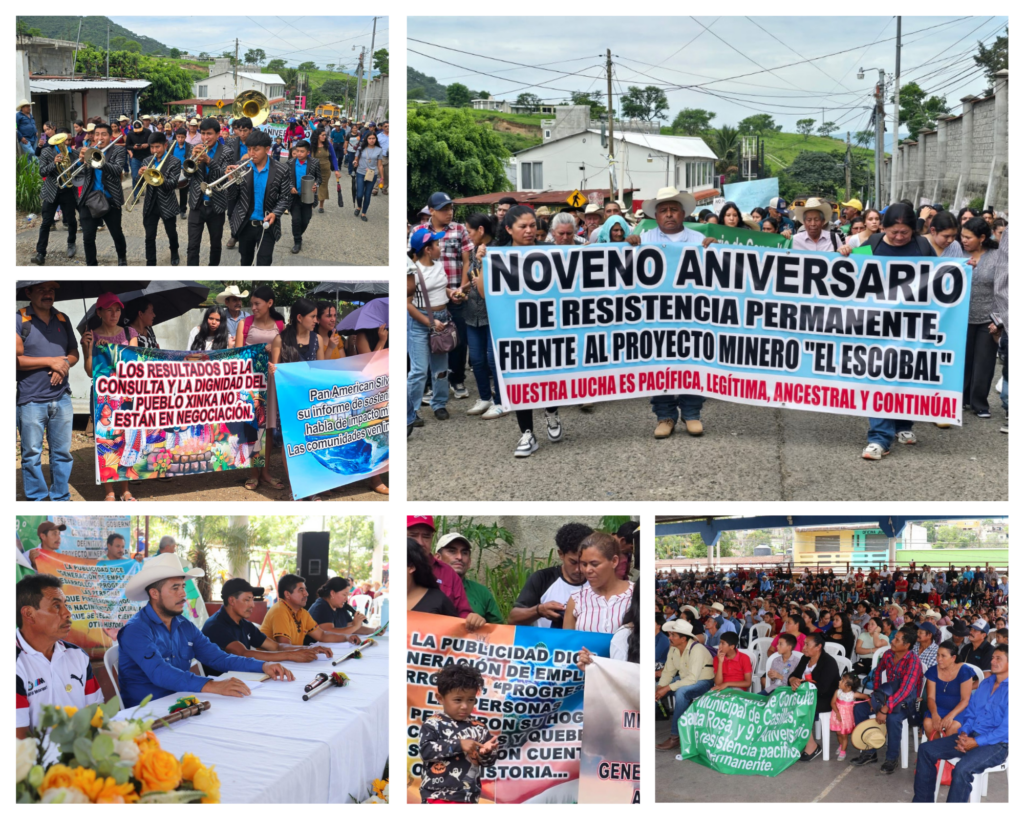
Women leading the way
Women have driven this resistance from the start. Daniel Orantes, who keeps watch at the encampment, described how mining company allies have tried to spread rumors specifically targeting the women who show up for shifts, hoping to turn husbands against wives and break the community apart from the inside. It hasn’t worked.
Marisol answered those attacks directly. The encampment, she said, has become a second home. “We women have also played a fundamental role in this struggle.”
Last year, she traveled to Vancouver with fellow delegate Marta Muñoz to tell Pan American Silver, the Canadian company behind the mine, exactly where the Xinka People stand. Asked whether any deal, even a majority stake in the mine’s profits, could change their minds, Marisol didn’t hesitate: “Even if they offered us 50% or 70% share in the operations, the answer is no… We simply want them to go away.”
Health and environmental impacts from the mine
This isn’t resistance for resistances’ sake. Experts hired by the Xinka People have documented arsenic and heavy metals in local wildlife and water. Wells that once supplied drinking water have dropped by as much as 120 meters. A sacred archaeological site was bulldozed down to a single mound. And the mine’s tailings dam, which is projected to be more than 150 meters tall and hold millions of tons of waste, sits in an earthquake zone prone to landslides.
In May 2025, after nearly seven years of a court-ordered consultation process, the Xinka People delivered their final answer: no consent for the mine to reopen. Pan American Silver has yet to publicly acknowledge that decision.
Remembering the past and determining the future
The Xinka People describe their fight not just as opposition to a mine, but as an act of remembering. Derek Mazariegos, a researcher with the Chiviricuarta Collective, spoke about youth recovering place names, oral histories, and traditional knowledge alongside the fight over water. Telling their own story, he said, is itself a form of power: it “shapes the way it has been represented and strengthens its capacity to determine what kind of future we want as a people.”
Nine years of holding a roadblock is extraordinary on its own. Doing it while also rebuilding language, recording history, and training the next generation of leaders is something else entirely. As Marisol said, closing out the anniversary: “For life and our territory, here we are, here we remain.”
Pan American Silver has still not publicly recognized the Xinka People’s decision to deny consent for the Escobal mine. Subscribe to email updates for opportunities to take action.