
|
Getting your Trinity Audio player ready...
|
Workers at Indonesian nickel plants power the renewable energy industry. But the costs are steep.
Along the coast of Sulawesi Island in Eastern Indonesia, workers at the biggest nickel industrial park in Asia, Indonesia Morowali Industrial Park (IMIP), produce the nickel that is found in stainless steel, carbon steel, electronic devices, electric vehicle batteries and other consumer goods. Foreign companies and the Indonesian government grow rich from the speculation over demand for renewable energy technology and electric vehicles. Workers have paid a steep cost for doing the actual labor needed for nickel production.
Between 2015 and 2024 there have been over 101 worker deaths and 240 injuries at Indonesian nickel plants, 40 of which occurred at IMIP. In response, workers have been organizing to demand better occupational safety and health protections. They have often been met with union busting tactics and hostility.
IMIP is a sprawling 4,000 hectare industrial park that employs over 80,000 workers. Indonesia has strongly prioritized developing its nickel industry in the last decade, and currently produces 60% of the world’s nickel supply. According to research from 2023, nickel industrial parks in Morowali, Obi Island and in Halmahera supply a group of nine factories that account for 40% of electric vehicle battery production making them a key part of the supply chain. Yet, the benefits of this growth have remained concentrated among Indonesian politicians and foreign investors, particularly from China and Korea.
Workers raise concerns about unsafe mine waste, long hours, and health issues
Some of these deaths have occurred in facilities where companies store toxic waste from mining, specifically in high pressure acid leaching tailings facilities. A report that Earthworks published earlier this year warns of the dangers that these facilities pose for workers, communities and the environment. Richard Labiro, director of the organization Yayasan Tanah Merdeka, stated that, “In Indonesia right now, these tailings facilities are a disaster by design. The risks created by the huge and growing amount of toxic waste are borne by workers, local communities, and the environment.” Just this year a worker at IMIP was killed when a tailings landslide buried the excavator he was operating.
Some researchers have speculated that the high number of workplace accidents and fatalities might be linked to the long work hours that appear to be a common experience among workers at IMIP. One work schedule at the industrial park involves working 12 hours for two shifts in a row which often results in a 60 hour work week. According to the WHO, working long hours is a “serious health hazard” and is the “largest occupational disease burden.”
Furthermore, workers have noticed growing health issues that merit further study and better access to treatment options. Recent research has shown significant air pollution around IMIP, specifically fine particulate matter (PM) levels that surpass the WHO guidelines by up to 10 times the limit during pollution peaks. High levels of PM have been linked to respiratory, cardiovascular, and cognitive problems. Workers at IMIP experience respiratory issues and health impacts from heat, noise and chemical exposure on the job. But beyond the unhealthy work conditions, the poor design and lack of regulation of these facilities, especially HPAL waste management facilities, cannot be ignored.
Workers pay the cost and offer solutions when mining isn’t safe
When we talk about frontline communities impacted by mining, it is important to remember that workers are often among those first impacted due to their proximity to projects. In the case of tailings management, there are clear examples of workers bearing the brunt of tailings mismanagement. One of the most horrific tailings failures, the Brumadinho failure in Brazil in 2019, had such a high fatality rate because the worker cafeteria was constructed directly below the tailings dam and the dam failed during workers’ lunch break.
In Indonesia, workers and civil society organizations are sounding the alarm as tailings facilities have caused workplace fatalities at multiple nickel sites, pointing to a systemic problem with tailings management and workplace safety across the industry. Workers often have valuable insights into the safety of mine waste facilities, and protecting whistleblowers from retaliation can help prevent accidents. Due to their expertise, workers and labor unions should also be an integral part of decisions made regarding occupational health and safety.
Workers reject recent contract negotiations as PT IMIP negotiates in bad faith
Last month, labor unions at IMIP underwent negotiations for a new employment contract. However, the outcome was rejected by union members, who allege that the company failed to follow proper procedures—altering the final draft of the contract so that it no longer reflected the agreements reached during negotiations—and, ultimately, disregarded many key demands.
On Saturday, October 31, workers occupied the offices of PT IMIP to protest the new contract, as well as the manner in which the negotiation and contract drafting process was conducted. They plan to continue their protests at government offices from November 3 – 7, to demand that negotiations restart in an open and transparent manner.
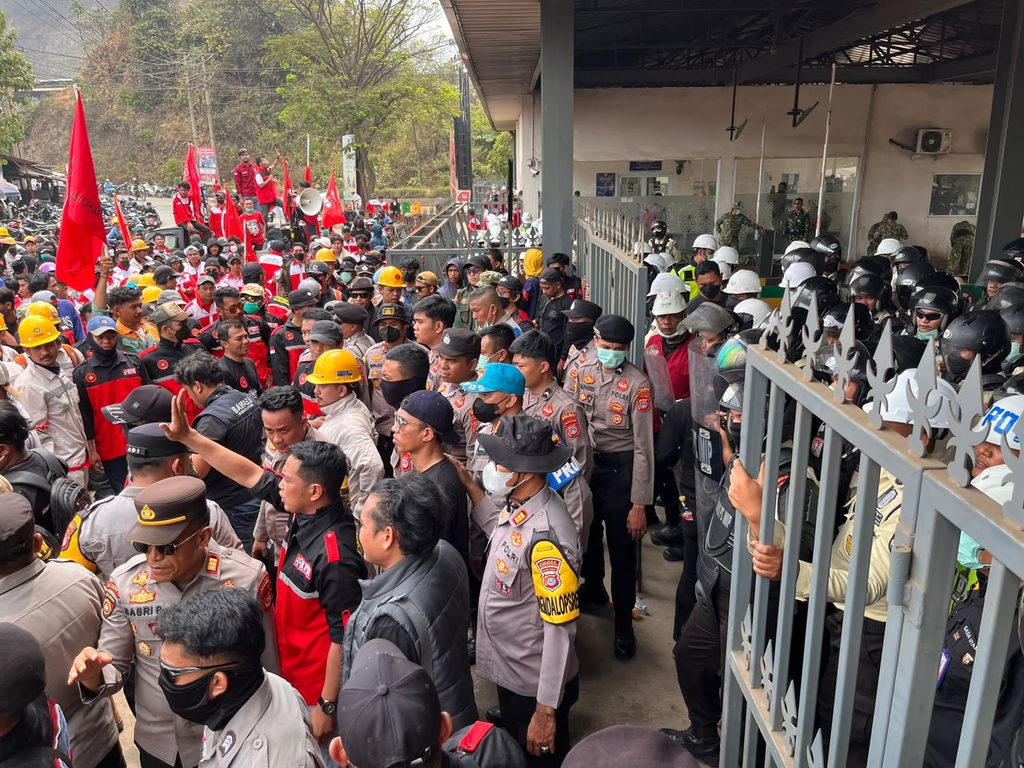
The membership of FSPIM, a union federation that organizes workers across three provinces in Indonesia, demands for IMIP management to:
- provide a living wage that increases in line with inflation;
- improve occupational safety and health practices with the goal of zero workplace accidents or fatalities;
- implement strict policies to protect women workers from sexual harassment and violence in the workplace and to simplify the process to access their legally-protected right to menstrual and maternity leave; and
- respect workers’ right to unionize and end all union-busting tactics, such as harassment, retaliation and layoffs.
A declaration on mining and the energy transition drafted by Earthworks and signed by 168 organizations and unions states that communities, the environment and workers’ rights must be put first for a truly just and equitable energy transition. The Declaration calls for centering the human rights of Indigenous, frontline communities, and workers and prioritizing solutions that reduce the overall demand for primary metals through strategies such as reuse, reduction, recycling, and design for disassembly. It calls for health and safety protections for workers and communities at all stages of the supply chain.
The environmental and community-level harms occurring at nickel mining sites in Indonesia are intimately tied to the horrible consequences of labor violations and lack of respect for the rights of workers. A just energy transition cannot follow the same extractivist patterns that caused the climate crisis. When companies fall into these old patterns, they cause interrelated harms towards workers, communities and the environment that stand in the way of truly sustainable progress.
It is imperative that IMIP swiftly heed workers’ demands and reopen negotiations in a fair and transparent way.