
|
Getting your Trinity Audio player ready...
|
On Tuesday, October 27, representatives from six communities dealing with the impacts of Canadian mining projects in Latin America and the Caribbean testified in a thematic hearing held by the Inter-American Commission on Human Rights. For years, these communities have fought to have their human rights and right to a healthy environment upheld both in their home countries and in Canada.
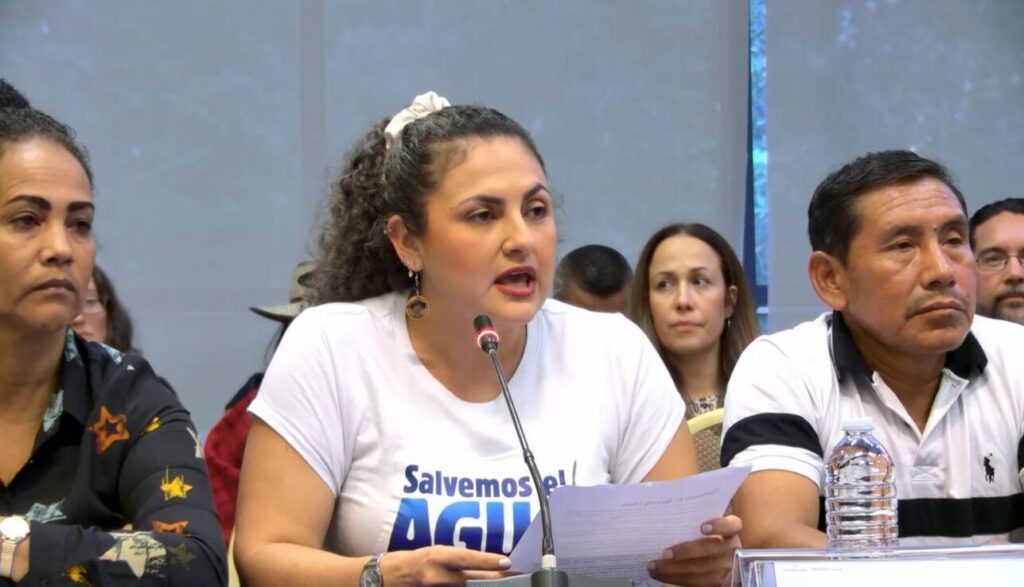
Corporate investment and abuses cross borders. Communities’ solidarity does too. At yesterday’s hearing, leaders from across Latin America and the Caribbean joined with Canadian and international NGOs to strengthen each others’ voices. Together, they posed a question to the Canadian government: The issues at each of these mine sites are well documented, so why hasn’t the Canadian government done more to hold Canadian mining companies accountable for their actions abroad?
Their testimonies show how individual community experiences add up to a pattern of corporate abuse that demands immediate action.
Canada’s government supports mining companies as communities call for action.
Canada’s laws and state practices provide political, legal and economic support that enables the sector… There are no effective mechanisms to prevent or investigate damages.
Charis Kamphuis, Justice and Corporate Accountability Project, Canada
Canadian stock exchanges are home to roughly half of the world’s publicly traded mining companies, but Canada does not hold the sector to strict and binding human rights and environmental due diligence standards. Mechanisms for corporate accountability in Canada fall short. Instead, it often uses its economic and diplomatic resources to support companies’ operations despite the impacts these have on local communities.
In Argentina, toxic spills contaminate the Jachal River.
For more than ten years, we have fought for our right to clean water… We have waited for more than ten years without response. We do not want more broken promises. We want clean water, justice, and guarantees that this will not repeat.
Saúl Zeballos, Argentina
Two witness testimonies heard yesterday relate to Barrick Gold’s operations abroad.
At the Veladero Mine in Argentina, five spills have contaminated the Jachal River with cyanide and mercury, and community members are still asking for the company to take responsibility for the contamination.
While mining company Barrick acknowledged the first three spills, in regards to two additional spills documented through independent water sampling, the company said it “is aware of the allegations regarding a recent incident at Veladero, and categorically denies them.”
In the Dominican Republic, concerns about pollution are met with bottled water and denials.
We have many health problems, both kidney and lung problems, vision problems, lead in the blood… We are suffering from a lack of water… I believe it is not acceptable for us to be living in the situation we are living in…Without water, there is no life.
Casilda Lima, Dominican Republic
At its Pueblo Viejo Mine in the Dominican Republic, residents living near one of the largest gold mines in the world have to deal with constant air pollution and impacts on water. Community members have had to drink bottled water for the past 15 years.
The company denies any responsibility and has not developed a permanent solution for the health issues and pollution that communities allege comes from their proximity to the mine. In response to a Guardian article about issues at the Pueblo Viejo mine, Barrick stated that it is “committed to operating in an environmentally and socially responsible manner. Contrary to the allegations, the water quality surrounding our operations has improved due to the extensive environmental remediation and water treatment activities we have undertaken.”
In Ecuador and Colombia, land defenders are imprisoned and harassed.
We have people who are unjustly criminalized for defending our rights, for defending our nature, for defending our water, our Pachamama.
Marco Manobanda, Ecuador
In Ecuador, the Curipamba-El Domo mine threatens the health, livelihoods, and water resources of local Indigenous and campesino communities. Land defenders who have spoken out about the impacts of the project have faced criminalization and imprisonment without due process.
Those of us who have raised our voices for 17 years have been stigmatized and labeled as belonging to groups outside the law…
We have gone to the authorities, we have gone to the courts, and the risk continues. That is why we have come before you today.
Mayerly López, Colombia
Members of the Santurban Committee protesting a Canadian mine project in Colombia have also faced harassment and criminalization.
In response to these allegations, Aris Mining claims “we remain steadfast in our assertion that we do not and have not participated in, nor do we condone, the intimidation of anyone.”
The Committee and UN experts have sent letters to the Canadian Government about the situation. Despite this, Canada has not responded or taken responsibility for the actions of Aris Mining.
In Panama, residents cannot enter their home communities without company permission.
Before we had to travel on foot through the mountain for many hours. Now, even though the road is much faster, the company controls it and complicates our access. There is a security checkpoint and they monitor who enters or leaves… If there is an emergency, and my family calls me, without a company ID, I cannot get to them quickly.
Why do we have to ask First Quantum for permission to pass if the company is on our territory? Instead of asking the Indigenous People for permission, they come to tell us what to do…
This testimony is anonymous because I am worried that they will threaten me and my community, or that they will prevent me from using the road to reach my family.
Name withheld
In Panama, Canadian mining company First Quantum Minerals has had its contract revoked twice by the country’s Supreme Court. Despite this, they continue to operate a checkpoint along the main road into the mine concession area. First Quantum Minerals told the media that the checkpoint is “only within the industrial zone itself” with “no restrictions in the remainder of the region.”
Nevertheless, nine communities are located within the concession area, and are required to have a company-issued identification in order to pass through, greatly restricting their freedom of movement. Canadian officials have repeatedly expressed their support for First Quantum and the company has filed international arbitration for $20 billion USD against Panama.
In Mexico, a community leader opposing a mine was murdered.
We are not saying that the [Canadian] Embassy ordered my father to be killed. But by denying him support for security, and by only working in favor of the company, we think that they put him at greater risk… Today, almost 17 years after my father’s murder, we are still seeking justice.
José Luis Abarca
In 2009, community leader Mariano Abarca was murdered for his opposition to a Canadian mining project near his home in southern Mexico. This was after the Canadian Embassy received multiple letters stating that Abarca feared for his safety. Canadian authorities have refused to investigate the case and a Canadian court claimed that human rights policies were not binding for government officials.
At the time of Abarca’s murder, Blackfire’s CEO claimed that the company “is not involved in this in any fashion…We’re just trying to continue working and moving forward with our projects.” Mariano Abarca´s son, José Luis Abarca, continues to fight for justice for the murder of his father. He testified on Canada’s obligations in the hearing.
It’s time for the Canadian government to uphold human rights.
Each of these communities have had their livelihoods, health, safety and wellbeing threatened by Canadian mining companies.
This is not the first time that these issues have been raised to the Canadian government. In a 2023 House of Commons hearing, Catherine Coumans stated that, “Harm caused or contributed to by Canadian mining companies, their subsidiaries and contractors overseas is widespread globally and persistent.”
Leaders from countries across Latin America and the Caribbean made their message clear: It is past time for Canada’s government to uphold international human rights standards and hold its mining industry accountable for the many harms it has caused abroad.