
The Indonesia Weda Bay Industrial Park (IWIP) and Weda Bay Nickel surround the village of Lelilef Sawai in a primary rainforest on the coast of Halmahera Island, North Maluku. These are the lands of the O Hongana Manyawa (more commonly, but against the wishes of the people themselves, referred to as Tobelo Dalam) and Sawai Indigenous Peoples. Tsingshan Group, Huayou Cobalt, and Zhenshi Group jointly own IWIP, and ERAMET is a French miner. Additionally, Tsingshan Group owns and operates Weda Bay Nickel, which supplies ore to the park. Nickel for EV batteries is processed using high-pressure acid leaching (HPAL), a process that consumes a significant amount of energy and generates substantial waste. Each year, HPAL operations produce approximately 120,000 tons of nickel, generating millions of tons of waste. This nickel is used by battery makers who sell to automakers such as BMW, Ford, GM, Tesla, Hyundai, and Volkswagen.
Indigenous Rights Violations
The companies failed to consult with local communities when scoping the project adequately. Deforestation has displaced many O Hongana Manyaya, who are traditional nomadic hunter-gatherers. While the forest has provided this indigenous population with all of their needs, including food, medicine, and spiritual and cultural practices, Weda Bay Nickel is linked to extensive deforestation of their customary forest. IWIP took control of farmland used by the Sawai for subsistence and destroyed the fish farm in Lelilif Sawai.
“For many of us in Gemaf, our customary land where we grow cacao, cloves and nutmeg is located inside the industrial park. Others have lost their land to the industrial park. And now our fishing grounds are polluted, and the shell fish are not safe to eat from pollution from the mining and the coal fire power plant. You can see the dust on our laundry, imagine how it is polluting our air and water.”
Max Sigoro, resident of Gemaf village
Environmental Impacts
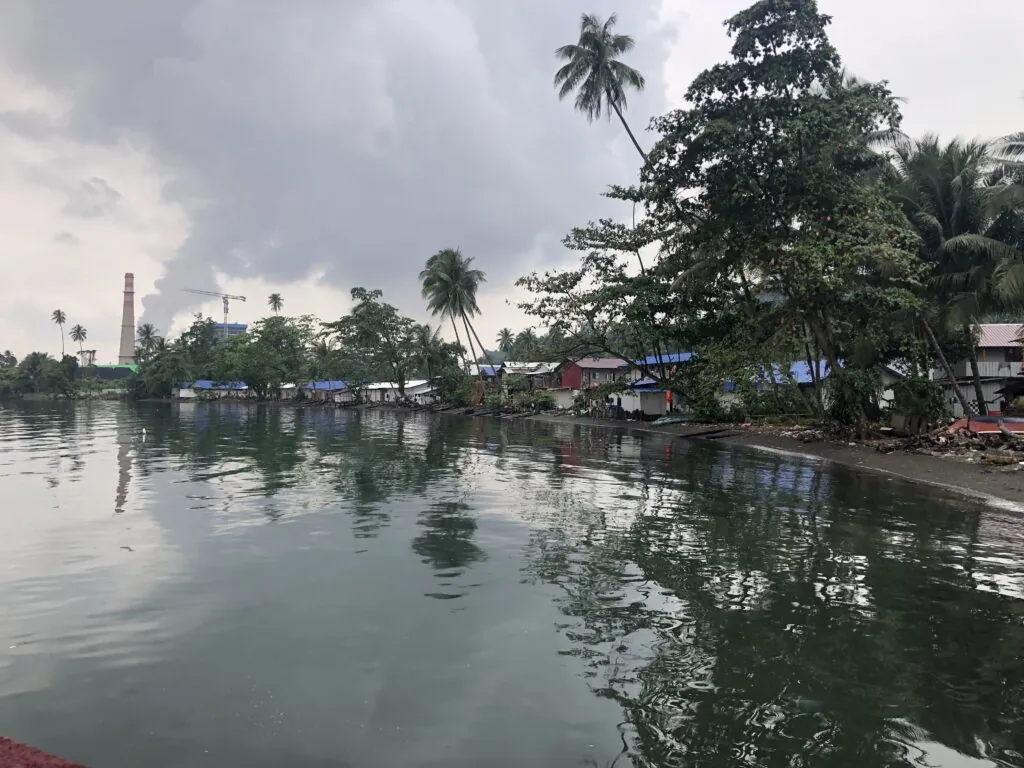
IWIP converted more than 100 hectares of mangrove forest to make way for a seaport, an airport, and other facilities for the industrial park. This, along with deforestation, has released sediment into the sea, thereby raising sea levels. The sediment damages coral reefs and destroys local fishing grounds, forcing villagers in nearby Gemaf and all along the coast to make long and costly fishing trips away from the village.
IWIP and Weda Bay Nickel threaten thousands of hectares of tropical forest in and around Aketajawe-Lolobata National Park, both directly through deforestation and indirectly through pollution. This includes important travel corridors for protected wildlife moving between different parts of the park. These wildlife travel routes were once proposed to be part of the park themselves.
Deforestation has led to devastating floods in areas surrounding IWIP since 2019. In July 2024, flooding shut down the villages of Woejerana, Woekob, Lelilef Waibulen, and Lukolamo, home to more than 6,500 residents, many of them nickel workers. Deforestation has also damaged the Kobe River, which villagers from Lukolamo depend on as a source for clean water.
For more information
- Report: Case Study of the CAO’s Approach to the PT Weda Nickel Mine Complaint: Barriers to Mediation in a Climate of Fear (Corporate Accountability Research, 2016)
Banner photo: Weda Bay nickel camp site at Tanjung Ulie cape on Halmahera island. Source: Muhammad ECTOR Prasetyo, Flickr