
|
Getting your Trinity Audio player ready...
|
One year into Trump’s presidency, the administration has moved aggressively to dismantle public health, environmental, and climate protections. The Trump agenda is delivering windfall profits to billionaires and large oil, gas, and mining corporations, while families pay the price through dirtier air, unsafe water, and higher costs. These rollbacks come alongside other federal actions that tear families apart and destabilize communities, leaving working families with fewer protections and greater risk. The result is a system where wealth continues to be funneled to the top, while everyday people face greater pollution, worse health impacts, and fewer protections in their own neighborhoods.
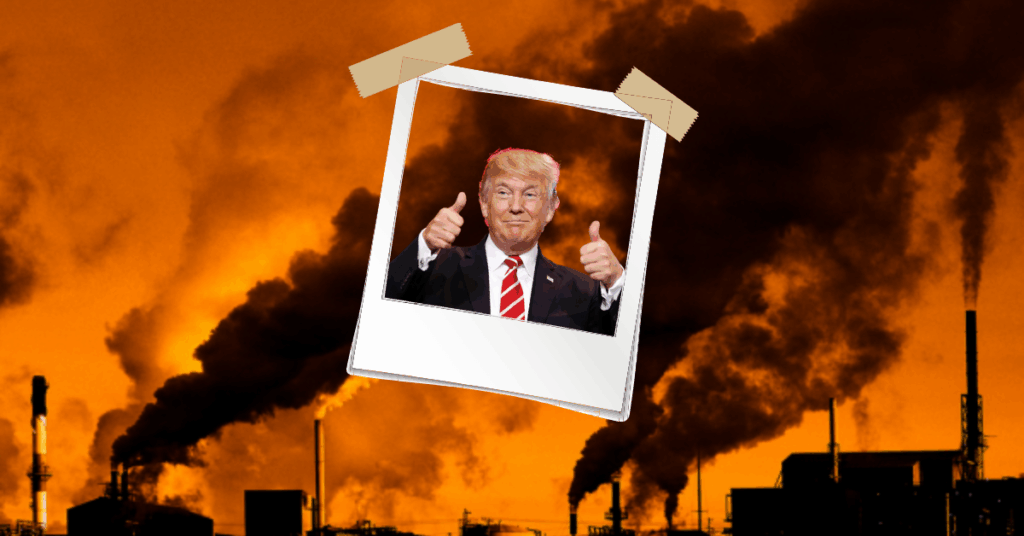
Central to the administration’s approach is dismantling bedrock environmental laws that have protected our air, water, and health for more than 40 years. Here’s a brief rundown of the harms we are committed to keep fighting one year into Trump’s second, disastrous second term:
Gutting of NEPA: Changes to the National Environmental Policy Act (NEPA), one of the United States’ bedrock environmental laws, move risk away from companies and onto communities, especially those already dealing with pollution. Meanwhile, billionaires walk away with the profits.
NEPA is a law that requires communities be given access to information about polluting industries near them and requires the government to assess how building and expanding sources of pollution impacts nearby families. It has protected the public since 1969.
Under the 2025 rollbacks, federal agencies are no longer required to fully assess climate impacts, cumulative pollution – the compounding harm of multiple sources of pollution close together – or concerns of harm on historically marginalized communities often referred to as environmental justice assessments when approving oil, gas, and mining projects – or any other projects that impact nearby communities.
Public participation has been limited, review timelines rushed, and scientific analysis treated as optional rather than essential.
Potential Dissolution of the Endangerment Finding: Along with gutting NEPA, the administration is also trying to undo the EPA’s Endangerment Finding, one of the most important tools for protecting public health and the planet. Established in 2009, this scientific determination confirms that greenhouse gases — such as carbon dioxide and methane gas — endanger human health and welfare. It serves as the legal foundation for regulating climate pollution under the Clean Air Act. Eliminating it would strip the federal government of its authority to limit climate pollution, leaving families more exposed to extreme heat, worsening air quality, flooding, and wildfire smoke.
Scaling Back Greenhouse Gas Reporting: At the same time, the administration has moved to halt or scale back the Greenhouse Gas Reporting Program, which requires major polluters to disclose how much climate pollution they release. For years, this data has allowed regulators, researchers, and communities to understand where emissions come from and how fast they are rising. Rolling back reporting makes pollution easier to hide and harder to regulate, cutting off transparency and accountability as climate risks grow.
Letting Methane Pollute and Pollute: The administration has also begun rolling back methane pollution protections by pushing compliance deadlines, with more rollbacks still underway. Methane is one of the most powerful drivers of near-term warming and a major source of smog-forming air pollution. Allowing oil and gas operators to delay detecting and repairing leaks increases pollution in nearby neighborhoods. The human impact of this is higher rates of respiratory illness like asthma, and more missed work and school days. While industry billionaires benefit from looser rules, families are left paying the price through higher health costs and long-term environmental damage.
Recent actions at the EPA further reveal just how far the Trump administration has gone to put industry profits over people’s health. According to a recent news article, EPA plans to stop considering public health benefits when crafting air pollution rules, abandoning a long-standing practice of valuing reduced illness and premature death in regulatory decisions. This shift makes it clear who benefits and who suffers: billionaires and industry executives take home huge profits while ordinary families bear the cost of pollution and disease.
President Trump is building a system set up to benefit billionaires and big fossil fuel and mineral companies, not ordinary Americans. Federal lands and waters are being opened to drilling and mining, clean energy incentives are being sidelined, and pollution standards are being weakened, all to keep money in the pockets of industry executives. Meanwhile, other countries are investing heavily in clean energy, which is safer and more affordable. By doubling down on outdated technologies, this administration is putting families at greater risk of pollution while also making everyday energy and food costs higher.
The administration’s retreat from global climate engagement amplifies the harms at home. By withdrawing from international climate commitments and undermining the scientific basis for climate action, the United States has stepped back from coordinated efforts to reduce global pollution. Climate change does not stop at national borders. Rising temperatures, worsening air quality, and extreme weather abroad directly affect food systems, migration patterns, disease spread, and economic stability here in the United States. Leaving the global stage does not protect American families — it exposes them.
Despite the Trump administration’s decision to prioritize billionaire cronies over community health, climate stability, and the financial well-being of ordinary families, there is reason for hope. Across the country, states and cities are stepping up to protect communities, invest in clean energy, and hold polluters accountable. Local leaders are showing that it is possible to put public health first, create good-paying jobs in cleaner energy, and reduce the costs of energy and healthcare for families. And communities in the United States and beyond are mobilizing to stand up to polluters and protect families and the environment.
Looking ahead to the 2026 and 2028 elections, Americans have the power to vote for leaders who prioritize people — not billionaires and polluters — and rebuild policies that protect our health, our wallets, and our future.