
|
Getting your Trinity Audio player ready...
|
Indigenous Land and Water Defenders Celebrate Arbitration Result
This is part one of a two-part series on the Peaceful Resistance La Puya and Kappes v. Guatemala. Read the second part here.
For fourteen years, the social movement Peaceful Resistance La Puya has maintained a 24-hour camp on the side of a dusty road just north of Guatemala City. The camp sits at the entrance to an open pit gold mine owned by Nevada-based Kappes, Cassiday & Associates (KCA).
A lot can happen in that time. Kids who grew up at the encampment left home and went to college. Elders who spent their days supporting La Puya passed away, their commitment memorialized in photos displayed on a banner.
This winter, what started as a handful of brave women risking their lives to physically block the entrance to the project in March 2012 contributed to a critical step in defense of land and water.
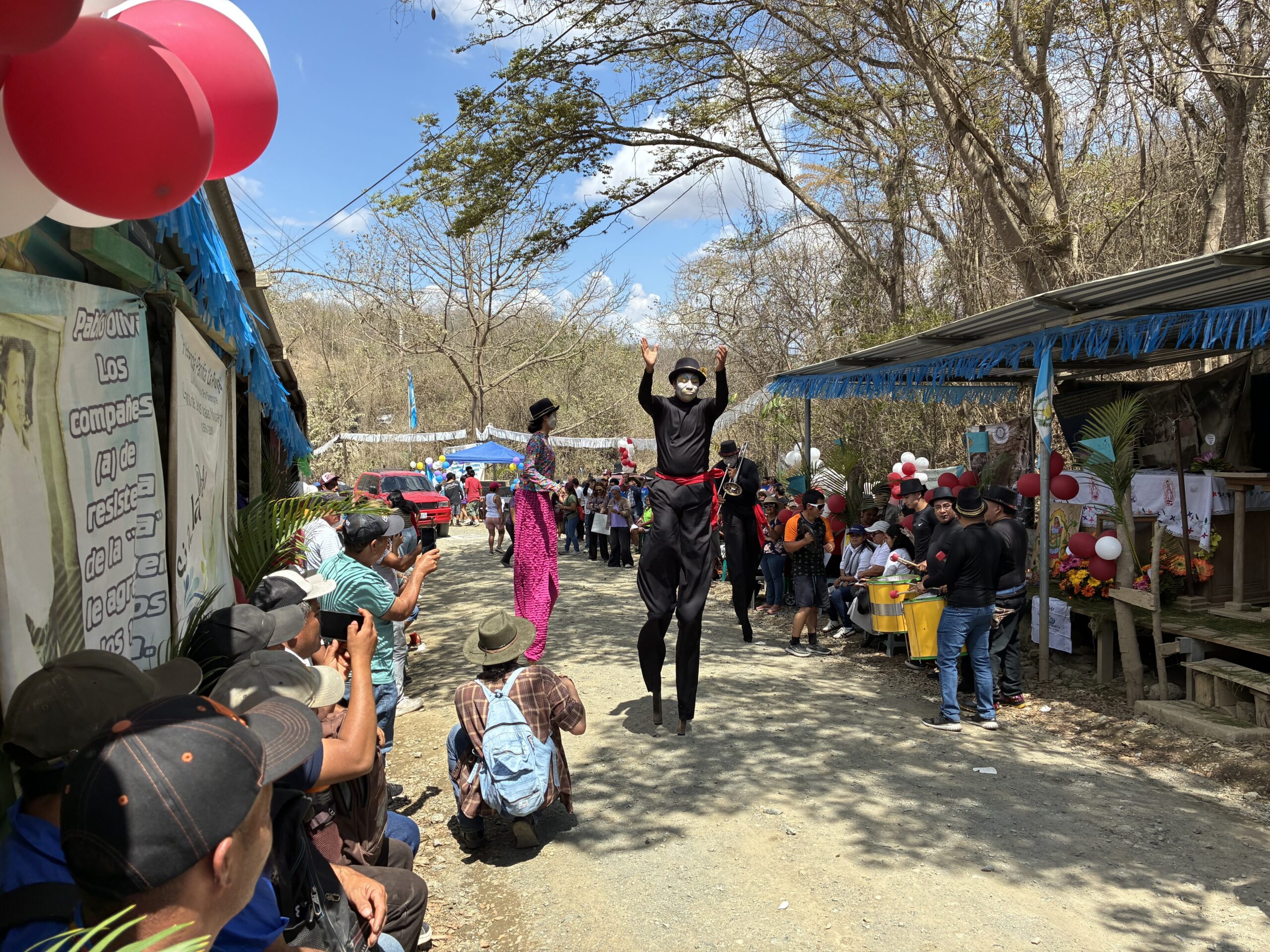
A Victory over Corporate Power
In 2016, KCA brought an international arbitration case against Guatemala for the Guatemalan courts’ decision to suspend operations at its mine. The case relied on privileges for transnational investors in the Central America-Dominican Republic Free Trade Agreement.
KCA sued Guatemala for nearly half a billion-dollars after La Puya’s legal actions achieved the suspension of the mine. A permanent decision from the government about the future of the mine depends on results of an as of yet ongoing court-ordered consultation with affected Maya Kaqchikel and Xinka peoples.
In December 2025, an arbitration panel at the World Bank’s International Centre for Settlement of Investment Disputes concluded that the country did not have to pay damages to KCA for the decision to close its mine. It will still need to cover over $4 million in legal and arbitration costs.
Peaceful Resistance La Puya contributed significantly to Guatemala’s defense during the case. Leaders pointed out that countries often face unfavorable odds in an arbitration system skewed in investors’ favor.
We feel satisfied and vindicated in our peaceful struggle. KCA lost its wager to make millions of dollars through this international arbitration process, which it initiated knowing that it would never win the consent of the communities that have always said no to its unviable project. This project is so bad that the company couldn’t even defend it in an arbitration system designed to protect the investments of transnational companies.
—Statement by Peaceful Resistance La Puya
An Unjust System
Investor State Dispute Settlement is a system envisioned by and for extractive corporations seeking to maintain control over the natural commons, especially in the Global South. As a one-way system in which only investors can sue governments through private arbitration, it only values corporate rights and deepens the already huge power imbalance between mining-affected communities and project-backers.
Investors can leap-frog over local and national-level decision-making to bring their cases to arbitration tribunals presided over by corporate lawyers. They can do this without having to exhaust every legal avenue in national courts. This system frequently excludes affected people from participation and has no obligation to consider their rights or perspectives at all.
Oil, gas, and mining companies are the most litigious in the ISDS system. Issues of Indigenous rights, community opposition and environmental protection often underlie their claims. These cases are used to coerce countries into ignoring these important priorities or to otherwise compensate firms for millions or even billions of dollars.
KCA’s suit was the first that Guatemala has faced from a mining company.
International Arbitration Cases Undermine Self-Determination
Over 2,500 free trade agreements and bilateral investment treaties include provisions that allow transnational investors to unilaterally sue governments before a private arbitration panel when decisions are made that they believe affect the value of their investment.
As a new report outlines, Guatemala exposed itself to ISDS claims when it began signing bilateral investment treaties and free trade agreements following the peace accords in 1996. Since then, it has faced 13 arbitration claims, over half of which stem from the energy sector and several of which — like KCA v. Guatemala —relate to underlying community struggles for water, collective well-being, and self-determination.
Another of these, also decided in 2025, did not go well for Guatemalans. Energía y Renovación Holding, a company owned by Guatemalan partners but registered in Panama, was awarded $64.5 million plus interest and costs. This company attempted to develop a hydroelectric project on Indigenous lands in the Yichk’isis (Ixquisis) Microregion of Huehuetenango despite the communities’ opposition expressed in a community-led “good faith” consultation and repression of the movement. Guatemala is attempting to annul this decision.
Overall, arbitration tribunals have ordered the government to pay more than $160 million to investors, an amount equivalent to more than three times the budget of Guatemala’s Ministry of Environment and Natural Resources in 2025.
While La Puya values the lessons they gained from an effective inside-outside strategy during the course of KCA’s ISDS suit against Guatemala, they recognize that the threat is ongoing. They are calling on Guatemalan authorities to review the commitments that expose the country to further suits.