We are standing strong because of your support. Thank you!
Since day one in office, President Trump has done everything in his power to upend environmental justice and climate progress. He has created a false “national emergency” to justify the expansion of dirty fossil fuels and mining. He has withdrawn from the Paris Climate Agreement. He has slowed the development of renewable energy infrastructure. He has prioritized polluters over people and corporations over communities on all fronts.
Not only are we not giving up, we are confident in our response. The road to transformative change is urgent, yet long, and it will take all of us together to make progress. Thanks to your support, we have been able to keep pressing forward to create a safer world for communities impacted by the mining, and oil and gas industries. We are defending at the federal level and fighting back at the state and local levels.
With your help ,we keep fighting.
Frontline Defense
Thwarting bad mining
In an important victory, we have repeatedly thwarted passage of the Mining Regulatory Clarity Act in the Senate. This bill would allow nearly unlimited access to public lands for waste disposal, pipelines, transmission lines, roads, and other uses “reasonably incident” to mining.
Advocating for communities
We’ve stood before Trump’s federal agencies as they threaten to take away vital protections and advocated for the communities most impacted by pollution. Most recently in August, Earthworks Policy Director Lauren Pagel testified to the Environmental Protection Agency (EPA) against revoking the Endangerment Finding, which, if reversed, would take away one of our greatest protections against unhealthy air.
Protecting each other from emerging threats
In recent months, we have seen escalating threats to the nonprofit sector and our constitutional rights. We are shoring up our organizational defense and working with digital security and legal experts to manage risks to our staff and organization. We are also sharing resources with partners and allies to support each other during this difficult period.
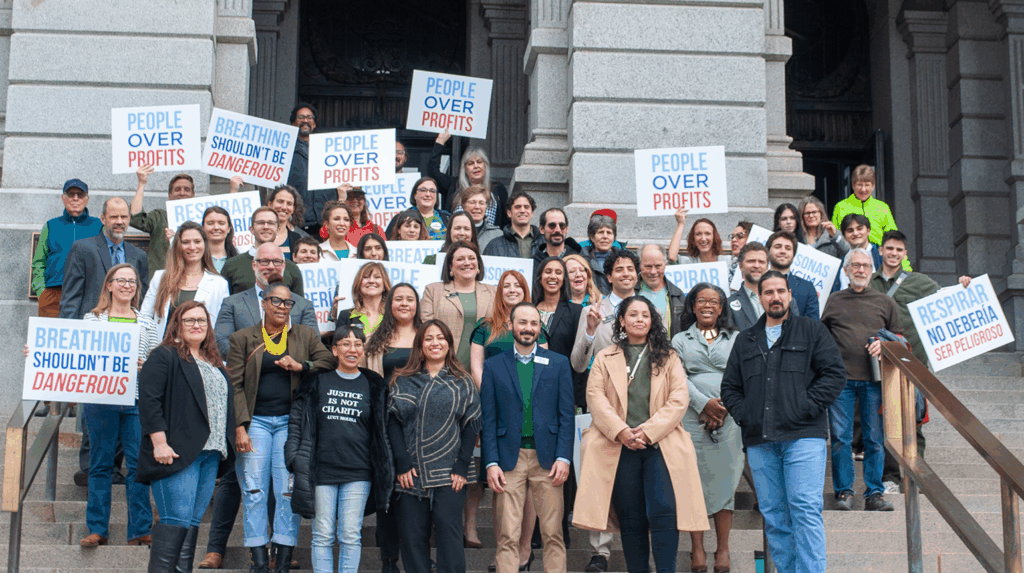
2025 Big Wins Across the U.S.
Blue Hydrogen Project Paused
Gulf Coast communities are fed up with false solutions presented by the oil and gas industry’s carbon capture and blue hydrogen schemes.
On May 2, 2025, Air Products announced that it is halting new spending on its $4.5 billion blue hydrogen project in Ascension Parish, Louisiana. Blue hydrogen is often touted as a “clean” form of hydrogen, using methane gas and steam to create hydrogen, then using carbon capture and storage (CCS) to store the waste carbon dioxide. Rather than serving as a genuine climate solution, carbon capture is being used by polluting industries to rebrand and prolong their emissions-heavy operations. Along with being an ineffective technology, CCS threatens land, water, and air quality, as well as property values, and has raised increasing concern for communities across the state.

Over the past few years, Earthworks has knocked on thousands of doors, met families one-on-one, and hosted monthly town halls to mobilize communities to stop this blue hydrogen project in Ascension Parish. And although the fight on this particular issue is far from over, this victory signals a huge shift in landscape.
This does not mean the threat of greenwashing is over. With your continued support, we will mobilize communities to advocate against false climate change solutions.
Satellite Technology Strengthening Emissions Evidence
Corporations and their Trump Administration allies are getting more creative in avoiding accountability for the messes they make. That’s why Earthworks is investing in new satellite monitoring data: to document methane pollution, to hold corporations accountable for that pollution, and to make sure states enforce their commitments to reducing methane pollution.
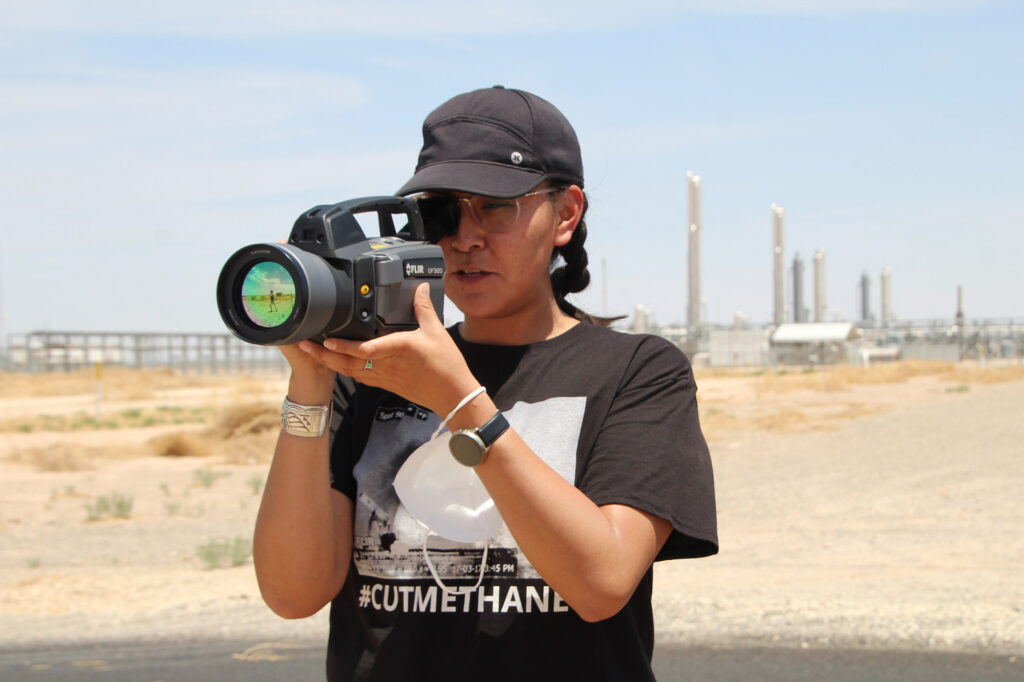
For over a decade we have deployed optical gas imaging (OGI) using an infrared camera to record oil and gas pollution that is invisible to the human eye. Now we are integrating OGI and satellite data to clearly attribute pollution to specific companies and locations and identify the severity of that pollution.
We’ve already seen evidence that this model works. Earlier this year Carbon Mapper’s Tanager 1 satellite identified a significant plume of methane at two oil and gas facilities in Weld County, Colorado. When Earthworks staff detected pollution at both facilities with OGI cameras, we submitted two complaints to the Colorado Air Pollution Control Division, using the OGI and the satellite data as evidence. This prompted state investigations, equipment repairs at both facilities, and a notice of violation to the operator of one of the facilities. We continue to work with regulatory agencies in key states to incorporate satellite data into their complaint and enforcement processes.
Victories in New Mexico
In a victory for community safety and health, the New Mexico Water Quality Control Commission voted in May that companies cannot dump toxic waste (aka “produced water”) into ground and surface waters. This waste byproduct comes to the surface along with the oil and gas, and contains toxic chemicals including arsenic and benzene.
New Mexico’s oil and gas industry releases approximately 84 billion gallons per year — a major threat to environmental and public health. Earthworks, along with a coalition of other environmental groups, advocated for these new rules to be enacted.
84 billion gallons per year of toxic wastewater is released by New Mexico’s oil and gas industry.
However, shortly after the new rule was adopted, the Water Quality Control Commission agreed to hear a new petition from an industry group seeking to reverse the protective rule. We anticipate the hearing to take place some time in the first quarter of next year.
Smoky Canyon Mine Cleanup
After years of advocacy and water sampling by Earthworks and the local community, the U.S. Forest Service ordered the mining company Simplot to clean up selenium levels at their Smoky Canyon Mine in Idaho. The phosphate mine was polluting waters across southeast Idaho into Wyoming with selenium. Selenium can persist in the environment for a very long time, and is dangerous to aquatic animals, from fish and birds to reptiles. Trout contaminated with selenium are known to give birth to deformed fish.
“The selenium levels are dangerously high — 2.5 to 4 times higher than EPA standards, and it’s highly dangerous to aquatic animals.”
— Bonnie Gestring, Northwest Program Director
Earthworks and the Crow Creek Conservation Alliance, a group of local affected private landowners, have been collecting water and fish tissue samples around the mine for years, and have repeatedly called for comprehensive water treatment at the mine. The clean-up plan requires the company to double the capacity of water treatment at the mine and to add more protective covers to waste piles to prevent water contamination.
No Man’s Land Documentary Wins Two Silver Telly Awards
In 2024, Navajo Nation Vice President Richelle Montoya joined us in the field to witness the direct impact that extractive industries have on communities in northwestern New Mexico. Shortly after, we released a short film, No Man’s Land, documenting the field tour.
This year it was awarded with two Silver Telly awards, honoring achievements in video. No Man’s Land sheds light on oil and gas corporations’ ongoing exploitation of Indigenous communities and the history of white supremacy. The work of these Indigenous leaders is more than activism — it’s a fight for survival for their people and the Four Corners region they call home. We continue to host field tours with Navajo Nation leaders to build support for action.
International Wins
Warriors for the Amazon: Ecuadorian Women Win Environmental Lawsuit
In 2020, nine young women, known as the “Warriors for the Amazon,” sued and won a landmark case against the government of Ecuador, called the “Mecheros Case.” Mecheros are flares that burn and release the greenhouse gas methane, as well as other pollutants that are harmful to health, at oil and gas facilities. It was argued, and proven, in this case that this practice harmed the health of nearby residents, specifically women and children.
In May 2025, Earthworks’ optical gas imaging (OGI) findings were used in a second case, challenging multinational energy company, ENAP, and the Ecuadorian government’s failure to end flaring and implement the sentence. This victory is a powerful demonstration of how OGI evidence can strengthen community testimony and lend power to voices that have been previously ignored.
OGI Documentation in Colombia
Earthworks’ optical gas imaging evidence contributed to an Environmental Investigation Agency (EIA) report, Crude Lies, documenting the harms of oil and gas pollution in Colombia. The BBC also released a documentary, Life at 50°C: featuring Earthworks’ OGI footage showing that petroleum giant EcoPetrol is violating the country’s methane rules prohibiting routine venting.
In 2023, Earthworks was joined by EIA for an in-depth expedition across Magdalena Medio, a pivotal region for oil and gas in Colombia, where the organizations confirmed 23 cases of greenhouse gas methane emissions in violation of Colombian law. The BBC documentary and the Crude Lies report call for Colombian government accountability to bring a fair transition away from oil and gas in the country.
Chile Lithium Mining—Speaking Truth to Power
Working with the Colla Indigenous Community of Copiapó, Earthworks is helping stop dangerous lithium mining projects that do not have community consent. Last year we published a report outlining what must happen to fully inform Indigenous Peoples, respect their rights and ensure that communities near lithium sites are protected. This year, communities underwent a government consultation process, and are working with Earthworks to leverage other pressure points, such as automakers.
Notable Reports from 2025

Your Support Makes Our Work Possible
Earthworks helps families on the front lines of mining, drilling, and fracking. We use sound science to expose health, environmental, economic, social, and cultural impacts of mining and energy extraction. To support our efforts, please consider a tax-deductible donation today that will go toward our work reforming government policies, improving corporate practices, influencing investment decisions, and encouraging responsible materials sourcing and consumption.