
Satellites are catching huge pollution events from the oil and gas industry in New Mexico. These events are going largely unreported by companies. The state’s new rule would hold them accountable.
New Mexico’s Environmental Improvement Board will hold a hearing to help hold polluters accountable on December 1-8. Here’s what our analysis shows and how you can help.
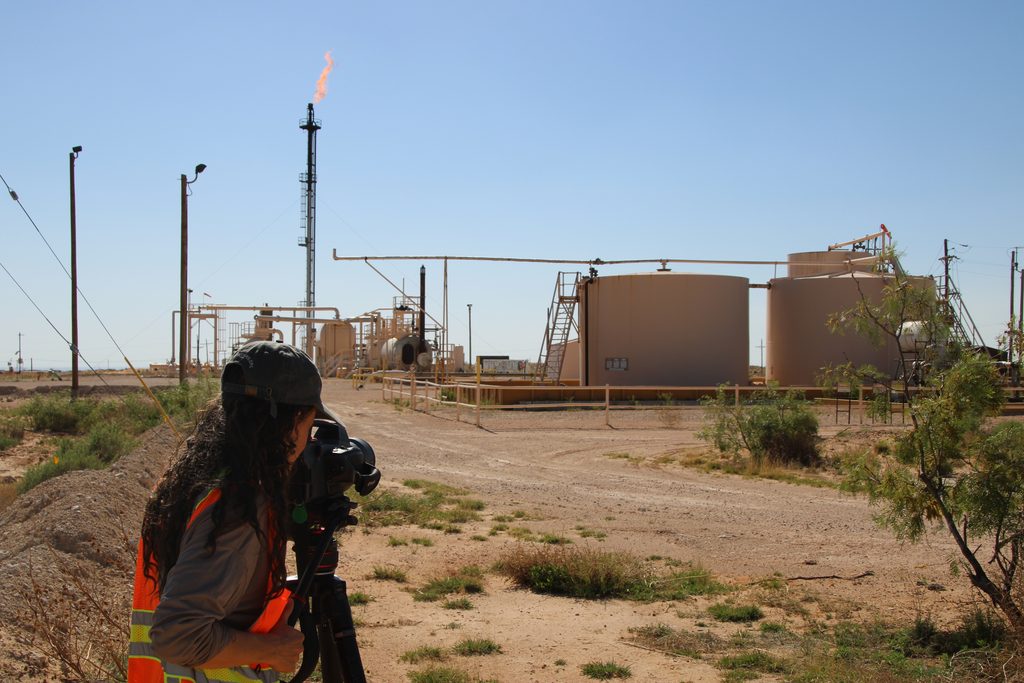
Most of the pollution coming from oil and gas operations, like methane, is invisible to the naked eye, but not to satellites now orbiting Earth and observing New Mexico. For years, operators in the Permian Basin and San Juan Basin have reported their own emissions to the state. Satellite data now lets the public check that work. Unsurprisingly, self-reporting is not working.
In October, Earthworks and the Gas Leaks Project released Plumes in the Permian, to review pollution in the New Mexico Permian Basin, part of the most productive oil and gas region in the country. Oil and gas companies are required to report pollution from their facilities to the state. In this report, we used publicly available satellite observations and our own optical gas imaging (OGI) field work, and compared it with that operator-reported data.
What did we find? In short, operators are NOT reporting. New Mexicans deserve more. A super-emitter program is the best answer right now.
The report findings:
The study covers January 1, 2025 through April 30, 2026.
- 166 super-emitter events (plumes of methane and toxic pollutants so large you can see them from space) were linked to 121 oil and gas facilities in the New Mexico Permian.
- One in three plumes was an extreme point source, meaning it released more than 500 kilograms of methane per hour. If the emission event were to last an entire day, that would be enough to power 70 homes for an entire year.
- Midstream operations: compressor stations, gas plants, and pipelines accounted for 105 of the 166 events.
- At 6 facilities, our OGI footage suggests emissions ran far longer than a single satellite pass captured.
- Modeling of 29 events found nearly 37,000 people in Eddy and Lea counties may have been at risk from unsafe benzene exposure. Benzene is a volatile organic compound created as a byproduct of the oil and gas extraction process; it is a known carcinogenic.
The most troubling finding is what operators told the state.
- For permitted facilities, only two percent of the plumes lined up with an excess emissions report filed with the New Mexico Environment Department.
- Only ten percent of facilities reporting venting and flaring data logged a significant event on the day a plume was seen.
- And forty-seven percent of facilities filing monthly venting and flaring data reported venting zero gas at those sites for the entire month.
The biggest polluters are midstream giants. Energy Transfer accounts for twenty-one percent of emissions observed, followed by Targa at thirteen percent.
The San Juan Basin has long been one of the country’s most visible methane hotspots from space. Satellite monitoring continues to show large releases from aging wells and processing infrastructure across the region, which sits beside Navajo Nation and Pueblo communities. Earthworks has also observed plumes consistent with satellite data in the Four Corners region, which also go largely unreported.
Why This Matters Now
These leaks waste a public resource, worsen climate change, and expose families to benzene and other toxic air pollutants. And most of them are going unreported. Many of these problems could have been stopped months sooner.
At the same time, the federal government is retreating. EPA Administrator Lee Zeldin used a visit to New Mexico in October to propose canceling the federal Super Emitter Program, the main tool that lets independent monitors flag large leaks and requires companies to respond.
New Mexico does not have to wait on Washington DC. The New Mexico Environment Department has proposed a state Methane Abatement Rule that would:
- Create a “super emitter program,” letting certified third parties using satellites, aircraft and other report sensing report large leaks to NMED.
- Set a low pollution threshold, so more serious leaks get caught.
- Require operators within 50 meters of a detected plume to investigate and repair the source.
- Require zero-emission pneumatic controllers, eliminating a major routine source of methane.
This rule is a common sense solution to a widespread problem that harms thousands of New Mexicans and our climate. Industry groups are already fighting to weaken or delay it, and the Board needs to hear support from the public and those who live with the consequences.
Take Action
The Environmental Improvement Board will hold its public hearing on the rule December 1-8, 2026. Members of the public can give comments in person or online.
- Sign the petition urging the Board to adopt a strong Methane Abatement Rule.
- Email me at asackett@earthworks.org to get more information about the December hearing, including talking points and logistics on how to participate. Share this post with your community.
It’s time we hold polluters accountable in New Mexico instead of relying on self-reporting.