
|
Getting your Trinity Audio player ready...
|
Residents of Louisiana’s “Cancer Alley” have defeated plans for what could have been the largest carbon sequestration and storage project in the world, adding to a long list of carbon dioxide facilities and pipelines across the state that communities have fought and defeated.
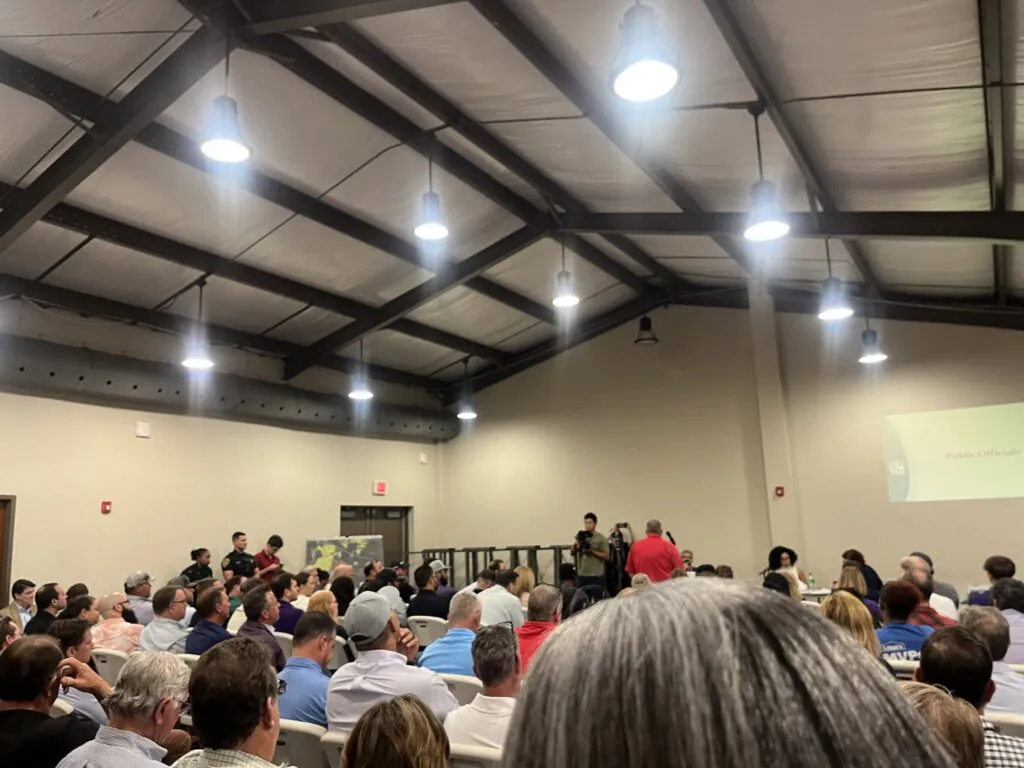
On July 30, Air Products announced they abandoned their so-called Louisiana “Clean” Energy Project, citing “expected financial returns not meeting stringent return criteria.” But we know the truth. Ever since the multi-billion-dollar project was announced more than four years ago, River Parish residents have demonstrated strong opposition to the project because of the considerable risks it would bring to communities, including:
- Building an ammonia plant and carbon dioxide pipeline right next door to a primary school, putting children and teachers at risk of pollution and leaks.
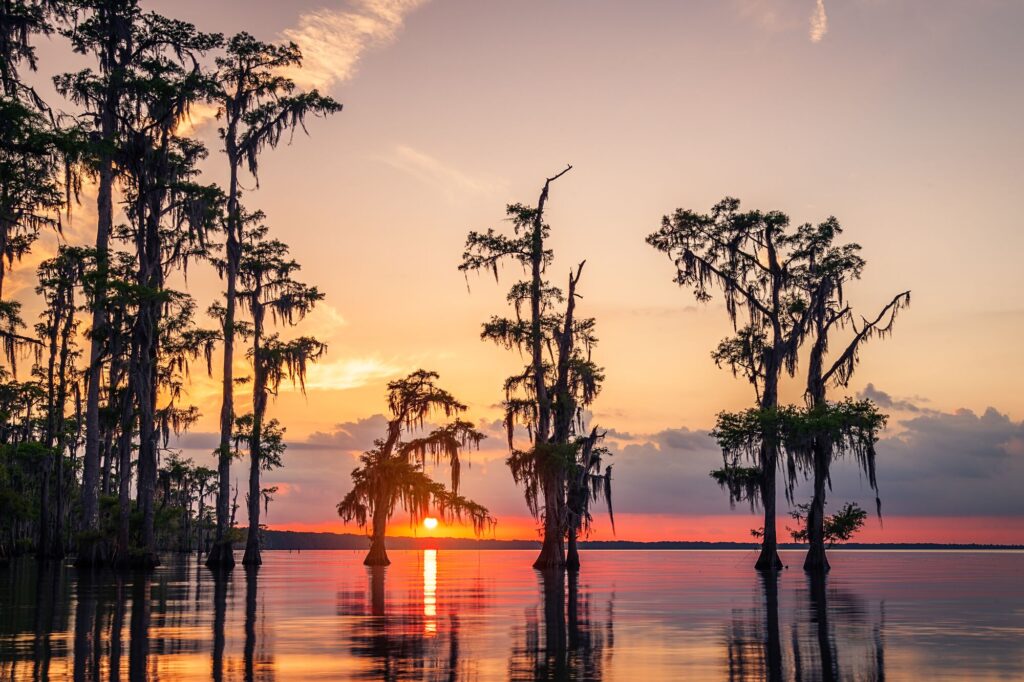
- Industrializing Lake Maurepas, turning a beloved lake and important ecosystem into a toxic wasteland.
- Being built on the site of the former Orange Grove sugar plantation, where local communities raised the alarm regarding the presence of unmarked graves of people who had been enslaved on the property.
- Using an unproven technology to bury carbon dioxide deep underground, turning communities and environment into testing grounds for something not guaranteed to work.
Kaitlyn Joshua and Logan Wolf, Earthworks’ organizers who both live in River Parishes, have helped build opposition to the project since it was first proposed with many partners, building common ground across a diverse group of stakeholders. All the town halls, door knocking, public hearings and comment writing workshops eventually led to this win, further demonstrating to the petrochemical and carbon capture industry that their era of unchecked expansion in communities is over.
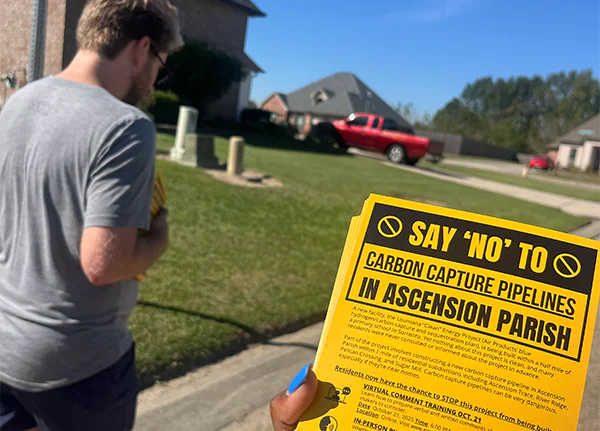
We sat down with Kaitlyn to hear more about this win, the carbon capture scheme, and how community voices shaped this outcome.
“So what I’m really noticing in this moment, and I think a lot of people can agree with this, is that it’s not a white, Black, Democrat, Republican issue,” Joshua says. “It is literally everybody’s issue at this point when it comes to CO2 build out across the state of Louisiana.”
Q: What does the blue hydrogen project being cancelled mean to the River Parishes and you personally?
A: Essentially, this particular halt of this project means that the work that we’ve been doing for years has merit, it has value, the grassroots organizing that we’ve been doing in these communities really does work. And most importantly it does mean that these industries are hearing our plea and understanding that folks are concerned about the impacts of carbon capture and storage and what CO2 pipelines could mean for the communities that they love, for the people that they love, for the kids that attend the schools, and for the neighborhoods that exist near these proposed pipelines.
Q: Why should people care about blue hydrogen and carbon capture?
A: I think that the reason why I’m so just committed to helping people understand why they should care about this particular technology is because it’s something that doesn’t work. It’s something that is kind of taking the focus off of something that could work and essentially put a place like Louisiana in a position to be able to address the climate crisis as we are seeing more aggressive hurricanes every single year, we’re seeing higher temperatures, more extreme weather. We used to not get tornado watches nearly as much as uh as much as we do now, and that’s something that’s extremely alarming and we need to be sounding the alarm — for lack of a better term — and helping industry understand that they play a major role in these climate crisis pieces and if we want to kinda make any type of change in this particular arena, then we’re definitely gonna have to work together to try and solve it instead of constantly coming up with fake solutions or false solutions.
Q: What’s the real impact on frontline communities?
A: Frontline communities stand to gain the least when it comes to carbon capture and storage. I know that the communities that I organize enjoy beautiful waterways and bodies of water across the state of Louisiana where we fish in, that we boat in. A lot of people have beautiful residential homes and retirement homes situated on these lakes and waterways and those would be completely dilapidated as a result of carbon capture storage. Literally — pipelines being constructed in the middle of these different bodies of water across the state.
We literally couldn’t have both anymore and I think what’s so sad about that is we’ve really done the work in south Louisiana to try to revitalize a lot of these different lakes and rivers so that people can enjoy them, so fishermen can continue their livelihoods, and that would be jeopardized as a result of CO2 pipelines being constructed, wells being drilled miles and miles underneath the lake and to what end? Right. And I think the moment that you allow one facility to take this on you’re allowing hundreds of facilities to take this on as Louisiana has already been coined as a breeding ground for CO2 pipelines. And that’s not just in south Louisiana unfortunately. We’re seeing that happen in central and making its way up to north Louisiana as well.
So what I’m really noticing in this moment, and I think a lot of people can agree with this, is that it’s not a white, Black, Democrat, Republican issue. It is literally everybody’s issue at this point when it comes to CO2 build out across the state of Louisiana. At this point everyone is becoming a frontline community. And I think that’s kind of in a weird way the beauty of us kind of coming together around this one particular issue that we have in common and being able to come up with creative ways to push back on it.
Q: You’ve been organizing on the ground for years—can you describe what that looks like and how community voices shaped this moment?
A: I’ve been organizing on the ground for a few years now and can describe a little bit what that looks like and how community voices have shaped this moment. And it’s been a delicate dance, if you will.
First, I’ll start by saying Earthworks supported on the lake side, so in particular around the Air Products blue hydrogen facility. That fight started on the Lake Mareupas side which is situated in Tangipahoa and Livingston Parish which is southeast Louisiana and essentially a very affluent part of the district, if you will, and typically very conservative, if you will, and a lot of time a lot of these folks don’t necessarily have to deal with an industrial build out or petrochemical build out as it is, and this was their first time ever fighting industry. You wouldn’t necessarily find them as — they’re definitely unsuspecting allies for sure.
Lake Maurepas to be exact, to be specific, was the main kind of common denominator if you will around organizing on the lake side and we had a um term or like a campaign, if you will, that was “Save the Lake” that Earthworks was really instrumental on helping with and really excited to support the folks within Lake Maurepas Preservation Society, which started out about three years ago.
The momentum kind of built two years ago around legislative session but also at the local level where the lake side folks were able to pass resolutions on the local level in Livingston Parish, Tangipahoa, and I believe one more. Where basically, local governing bodies, we have city councils and Parish councils, who pass resolutions saying they did not want Air Products to come into Lake Maurepas, destroy it.
As I already alluded to earlier, Lake Maurepas took years or advocates took years to revitalize and constantly try to advocate on behalf of the lake which led it to becoming a wildlife management center officially. And so that fight was very interesting.
It was very much like, if it can be quite candid, a lot of white folks just, you know, advocating on behalf of the lake and, you know, us, you know, people of color, we have a very diverse group of folks organizing with Earthworks, supporting that work and we had to, you know, be very cautious in the way that we were organizing as we didn’t wanna kinda overlay the plan that we’ve used in the agenda and the lens of which we’ve organized is what I’m trying to say for the last few years. In certain other parts of the state we couldn’t just kind of, you know, use that same blueprint right over to Livingston and Tangipahoa, we had to kind of take the lead of the folks in that area, so that was a very unique thing.
All in all, it worked out. We’re still in community, still building with the folks on the lake side, and now that we’re on the Ascension Parish side, also organizing in St. James and St. John.
And to be clear, St. James and St. John are the parishes that would bear the brunt of the CO2 pipeline construction. Ascension Parish is where the facility is situated, where the official announcement has happened from Air Products, where they have decided to halt construction of the CO2 carbon capture facility in Sorrento-Darrow area.
And so now that we are organizing this side, it’s also very interesting because it’s a mix of Black and Brown, white folks that are also pretty well off that typically enjoy, you know, a very luxurious lifestyle for the most part. Their kids go to really good schools, a great deal of them are already a part of industry but don’t necessarily buy into carbon caption storage and what that is and what that means and a lot of them are very well aware, very educated on the fact that carbon capture and sequestration has not worked anywhere in the world and they’re not bought into it right and Air Products has not sold them on the technology.
And so for them, it is the pushback on; I don’t want CO2 pipelines constructed near my home, what does this do to my property values, what does this technology potentially do, or what does a pipeline rupture or leak look like near the school that my kids attend. Right
So the conversations are a little different, but no matter what, those different narratives have certainly shaped the feedback and the responses and the public comments that we’ve dispersed throughout the different public hearings that we’ve been able to participate in in the last few years, whether in Baton Rouge at the primacy hearings or in Ascension Parish, or in St. John, St. James, or Livingston on the lakeside. And it’s been very interesting and really exciting to see people’s different world views on how they take on this CO2 pipeline facility.