
|
Getting your Trinity Audio player ready...
|
It’s been five years since the Port of Corpus Christi granted lease approval and pipeline easement for Phillips 66 and Trafigura to construct the Bluewater Texas Terminal. The project involves building 55 miles of onshore and offshore crude oil pipeline through San Patricio County, Texas and a deepwater port approximately 15 nautical miles off the coast of Corpus Christi. Today, the project remains a high-risk, improbable endeavor for several reasons.
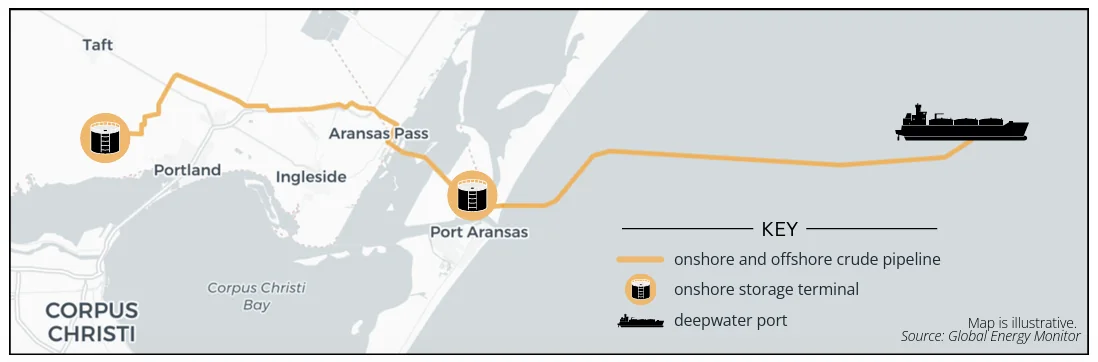
Regulatory Hurdles: Now six years in, Bluewater Texas Terminal is struggling to get necessary approvals, with no permits issued. Deepwater port projects can stall indefinitely, tying up capital without revenue.
Declining Long-Term Demand: Deepwater ports are built for 30-40 years of service, but the International Energy Agency (IEA) projects peak oil demand before 2030. Massive infrastructure that takes 3-7 years to build could become underutilized within years.
Market and Commercial Uncertainty: Another deepwater oil port, the Sea Port Oil Terminal (SPOT), is struggling despite federal approvals. SPOT’s cost ballooned from $1.85B to $3B, and it still lacks long-term customer contracts and financial backing.
Overcapacity Risk: The Port of Corpus Christi and the U.S. Gulf Coast already has substantial crude export capacity. Additional capacity from projects like Bluewater Texas Terminal may exceed market demand and lead to underutilization.
Stakeholder Resistance: The terminal faces intense opposition from environmental groups and residents due to significant air pollution, ecological damage, and the project’s impact on low-income and minority communities in the Coastal Bend.
Environmental Risks: Bluewater would introduce pipelines through sensitive estuaries and bays. As part of a broader expansion of offshore export terminals, the project adds to projected emissions of 24 billion metric tons of CO₂ over 30 years from these facilities—equivalent to running thousands of coal plants.
Bluewater Texas Terminal Impacts at a Glance:
172
Very Large Crude Carriers (VLCCs) per year contributing to ship traffic
$31.9B
Projected climate-related social costs
29.98
Acres of total wetlands permanently and temporarily affected
12,160
Pounds per year of hazardous air pollutants emitted
150.4
Tons per year of health-harming Volatile Organic Compounds (VOCs) emitted